
- Harvesting our clay for pottery
- London Clay
- Harvesting the Clay
- Clay test pit
- Processing the Clay
- Barrel Firing
- Register interest in our Clay Workshop
Harvesting our clay for pottery
A number of our volunteers have shown interest in using our clay subsoil onsite to make some low temperature wood fired ceramics. That comes as no surprise to anyone who’s tried to dig at Meadow Orchard Project, it’s pretty much pure yellow London Clay! Meadow Orchard has very little topsoil (it used to be tennis courts, clay courts maybe?) the site has previously been levelled and had a thick layer of clinker drainage added. Looking at the site in winter, it’s prone to waterlogging and this is mainly because it’s almost pure clay, with no real organic matter to help absorb the winter rains.

London Geology is interesting, digging around North London, Finchley and Muswell Hill in particular results in a lot of London Clay mixed in with Flint and Chalk, also known as Boulder Clay, It’s full of remnants from it’s glacial past, (fossilised sea creatures) from when it was largely frozen seabed!
London Clay
Discovering our local geology is far more fun when armed with a trowel, a spade and in our case a 200mm diameter well auger…(don’t ask!). The unique geology has led to local brick pits for harvesting clay and of particular local interest was the recent replica Roman Kiln at nearby Highgate Wood (https://www.highgateromankiln.org.uk/).
As a permaculture site, we are naturally attracted to sustainable, low impact, locally sourced materials, with a strawbale / cob, clay built roundhouse, and a puddled clay natural pond on site, harvesting our own wild clay for pottery is clearly the next step.
We didn’t really need much encouragement and the thought of combining biomass, fire, some kind of improvised kiln or pit kiln to fire the ceramics was just too intriguing not to explore. An enquiry on a facebook group, soon put us in touch with local creatives, artists and ceramicist who were also intrigued at the prospect!
Using clay is also terrifically engaging and after getting to grips with the material it’s really therapeutic too. Working with clay is such a lovely group activity, watching how people respond to the material, play and learn.
Harvesting the Clay
In the Spring we will be starting to harvest, process and test fire some examples of clay from the Meadow Orchard site. If you have read the above, made it this far and would like to find out more, please click the link below, send us a message and we can keep you in the loop.
We will be updating this post as we progress with our test pits, we already have a lovely group of local ceramic artists interested so it’s looking to be a really fascinating series of workshops.
Clay test pit
Edit 29/01/25 As the weather warms up (we’re optimistic) we’ve already dug a little test pit so our local potter friends can process the clay, fire some test pieces and get more idea how well the clay will fire in the lower temperatures in a wood pit or barrel firing. Initial tests look great, we are very excited! We can’t wait to see the results! The clay is super sticky and malleable, all the kinds of thing that are great for pottery but bad for growing plants!


Processing the Clay
Edit 05/02/2025 A small sample pot was fired previously, this gave a good colour and really started getting us excited with the project, however it wasn’t much of a gauge to see how larger pieces will stand up to the violent firing process in a wood firing, a fast rise in temperature. To help prevent cracking in the firing, the next step is to add “grog” to the clay to help it survive the thermal shock from the rapid temperature change. To make grog, we will fire some flint (found on site naturally) in a kiln.
Roasting the Flint to 1000 degrees Celcius in a kiln to produce Calcinated Flint, which makes the flint easier to grind. T fired flint is crushed & ground in water in a grinding pan.
The next step after processing the clay is to sculpt the pots, and allow to dry. The initial test pieces will be fired in an electric kiln to establish the firing temperature prior to some barrel test firings to establish the method and size and type of wood to fuel the burn.
Edit 26/02/25 We’re currently in the process of preparing our clay, experimenting with various processing methods and additions to determine what will work best for our next test firing. This involves carefully testing each approach to see how the clay responds under different conditions. While it’s a time-consuming process, gathering these results will allow us to better understand the properties of the clay we have on site. This will help us refine our technique and improve the success rate in the wood-fired barrel kiln, ensuring better outcomes for future firings.”
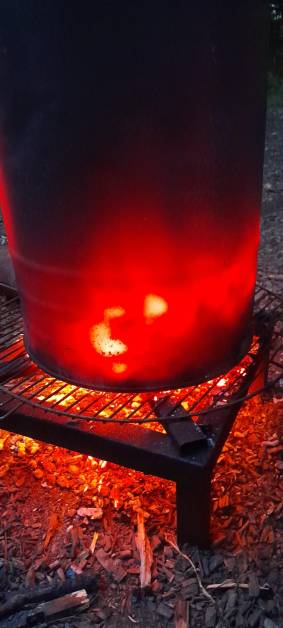
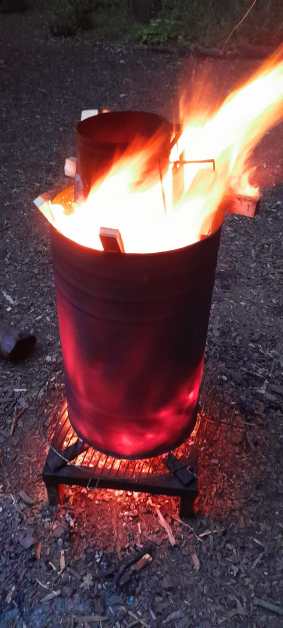
Barrel Firing
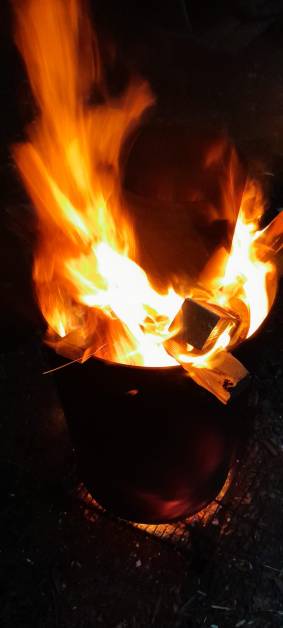
Barrel firing is a method of firing ceramics, where pottery is placed inside a metal barrel or drum and wood is used to fuel the burn. This method is quite primitive, almost just a contained version of a pit kiln. Ceramics fired in this method can have rather unpredictable results, from smoke and colours from oxides which is very much a part of its charm.
The process typically involves placing the ceramic pieces inside the barrel along with pieces of wood, sawdust, and sometimes other materials like leaves, paper, or straw. The fire and the smoke from the combustibles interact with the ceramics, creating distinctive colourations, patterns, and textures on the surface of the pottery.
Barrel firing is often used to create primitive, rustic, earthy effects that can’t easily be replicated with more controlled kiln firing methods, such as an electric or gas fired kiln. The random nature of the process—due to variables like how the fire burns and the type of materials used—makes each piece one-of-a-kind. It’s a popular technique among ceramicists looking for more experimental and organic finishes for their work.
Register interest in our Clay Workshop
We are currently planning on running the wood fired ceramics activity at Meadow Orchard Project. We don’t yet have dates in mind but they will be scheduled in Spring / Summer ’25 when the weather warms up!
If you’d like to register your interest in these activities and receive future email updates please use the link below. It would be great if you could indicate your level of ceramics experience, if you are a complete beginner or more experienced ceramic artist looking to learn more about primitive wood firing.
Please also indicate if you would like to involved in harvesting local wild clays, processing material, sculpting, pinch / coil pots and partaking in the barrel firing to make the completed ceramics. We can accommodate around ten to twelve at workshops, so unfortunately places will be limited. Email us to register interest in the upcoming workshops.
 Meadow Orchard Project
You must be logged in to post a comment.