
- Low voltage lighting in our Roundhouse
- Date and Time
- Help us install lighting
- Our Solar System
- Solar Charge Controller
- Amps x Watts = Volts
- Series and Parallel
- Upgradeable
Low voltage lighting in our Roundhouse
We are going to add a lighting system in our Roundhouse classroom. This will increase its usability for our site users. We are planning to install a low voltage (12 volt) solar system to provide off-grid power. For lighting we will use very efficient 7 watt LED spotlights. Spotlights are directional and can be directed upwards as a ceiling ‘wash’ to illuminate our lovely reciprocal roof!
The amount of power stored from the sun in the batteries depends on several factors. These include the solar panel size, the average length of the day, shading, and the direction the panels face. Our system is small and primarily charges the battery to power lighting. The system also includes a small 2000 watt inverter. The inverter supplies 240 volts for a projector, laptop, or a small PA system for a concert. This setup was used during the recent event with Stacey Cohen.
Date and Time
Date: Wednesday 12th February 2025
Time: 12.30 – 4.00pm
Location: Roundhouse, Meadow Orchard Project
Help us install lighting
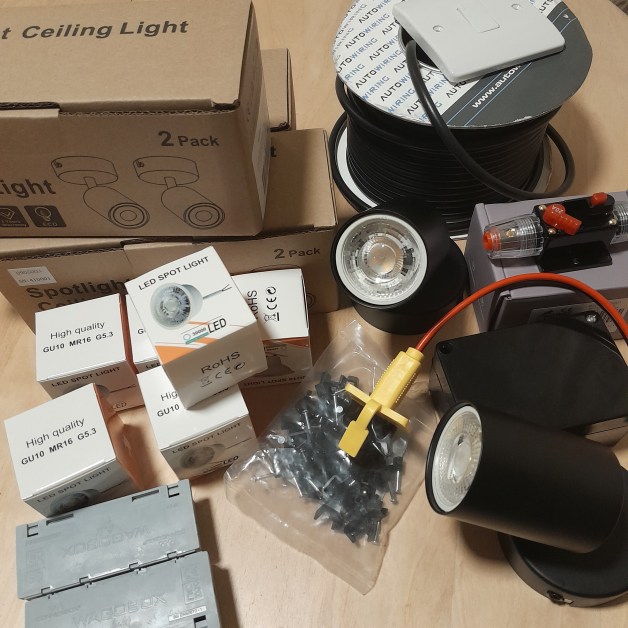
If you’d like to lend us a hand installing the lighting, let us know. We can also show you how our solar charge controller works. Send us an email or click the link below.
Our Solar System
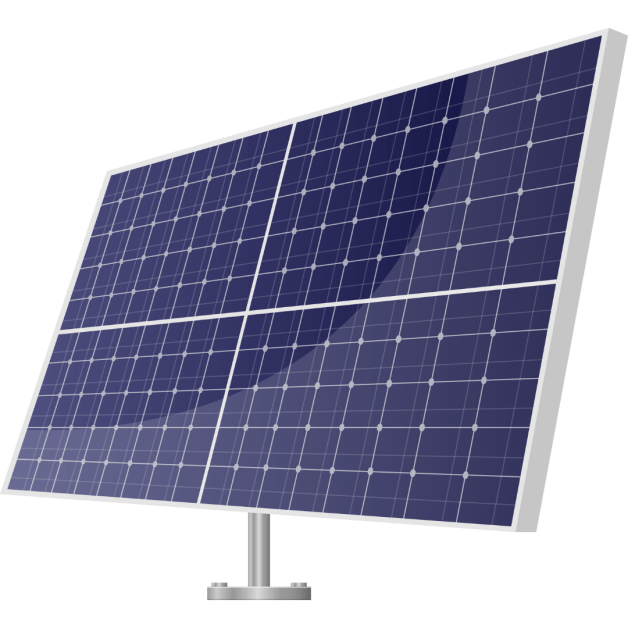
We are using a 100watt solar panel (Photovoltaic Panel PV). We also have a small MPPT Maximum Power Point Tracking charge controller. Additionally, there is a deep cycle leisure battery to store the power from the solar panel.
Amp hours or Ampere hours (Ah) is a unit of measurement used to describe a battery’s capacity. It indicates how much power a battery can deliver over a specific period of time. Our 100 Ah battery can in theory supply 1 amp of current for 100 hours, or 2 amps for 50 hours. The higher the Ah rating, the more energy a battery can store and supply. This means it can power devices for longer periods before needing to be recharged.
Solar Charge Controller
A solar charge controller regulates the voltage and current coming from the solar panel to the battery, this makes sure that the battery is charged safely and efficiently. It prevents overcharging by limiting the amount of power sent to the battery once it’s fully charged. It also prevents deep discharge by disconnecting the load when the battery voltage gets low.
Amps x Watts = Volts
Watts (W), amps (A), and volts (V) are related electrical units that describe power, current, and voltage. Here’s how it all works:
- Volts (V): Voltage is the electrical potential difference between two points. It’s the “push” that drives the flow of electricity in a circuit. You can think of it as the pressure that forces electricity to flow through wires.
- Amps (A): Amperes (or amps) measure the flow of electric charge, or current, through a circuit. It represents the quantity of electricity moving past a point per second.
- Watts (W): Watts are the unit of power, representing how much energy is being used or produced over time. Power (in watts) is the result of both the voltage (V) and current (A). The relationship is given by the formula:
Watts (W) = Volts (V) × Amps (A)
An average cyclist for example can produce around 200 watts for an hour, One horse power is equal to 746 watts.
In essence, volts are the force. Amps represent the flow. Watts indicate the amount of energy being used or generated.
Series and Parallel
Solar panels can be installed in both parallel and series configurations, depending on the desired outcome and the system’s design.
- Parallel Configuration: In a parallel setup, you connect the positive terminals of all panels together. You also connect the negative terminals together. This configuration increases the total current (amps) while maintaining the same voltage as a single panel. It’s useful when you need to ensure a higher current output. This setup is beneficial if panels might be shaded or have slight variations in performance. The performance of one panel won’t significantly affect the others.
- Series Configuration: In a series setup, the positive terminal of one panel is connected to the negative terminal of the next, creating a chain. This increases the total voltage (volts) while maintaining the same current. Series connections are commonly used to match the voltage requirements of charge controllers or inverters.
In practice, solar systems often use a combination of both series and parallel configurations to optimize voltage and current based on the specific needs of the system.
Our system is a single 100 watt, 12 v panel. If you connected two of these panels in parallel, the voltage would remain at 12 volts. However, the wattage would increase to 200 watts (100W + 100W = 200W). If two panels were connected in series the wattage would remain at 100 W but the voltage would increase to 24 volts (12V + 12V = 24V).
Upgradeable
Although our system is small it is possible to upgrade in future if and when there is demand. Although it is small it is still a good demonstration of the operation of a solar power setup.
It is very useful to be able to recharge our 18volt powertools, worklighting and torches on site. Last year we were building solitary bee habitat in our outdoor workshop. We needed to drill many holes in logs. The deep holes were up to 10mm in diameter and the battery charger was in use all day long!

 Meadow Orchard Project
You must be logged in to post a comment.