
- Plasticity
- Learning about our clay at Meadow Orchard
- Firing clay
- Low firing
- Vitrification
- How wood firing differs from a conventional kiln firing
- Harvesting the clay
- Processing the clay
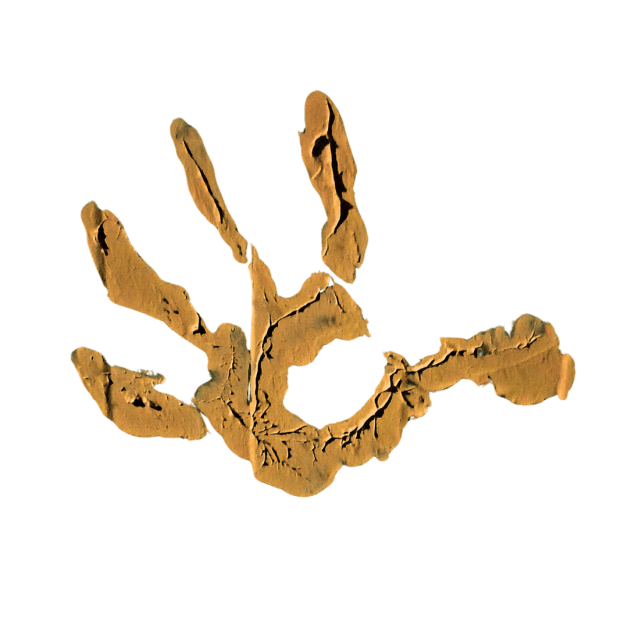
Plasticity
Clay is a wonderful material, when it’s wet it can be moulded and when it’s dry or fired becomes amazingly hard and durable.
Water makes clay plastic because it acts as a lubricant between the tiny clay particles, allowing them to slide past each other. Clay consists of extremely fine particles which can absorb and hold water molecules. When water is added, it forms a thin film around these particles, reducing friction and making the clay flexible and mouldable.
This property, called plasticity, allows clay to be shaped without cracking and is crucial for pottery and ceramics. However, if too much water is added, the clay becomes too soft, slumps and loses its ability to hold its shape.
Learning about our clay at Meadow Orchard
Clay is a remarkable material. When heated, its properties change significantly due to chemical and physical transformations. Initially, water evaporates from the clay, making it dry and brittle. As the temperature increases, organic materials burn off, and the clay particles begin to fuse. Around 600–800°C, the clay undergoes irreversible chemical changes, becoming harder and more durable. At even higher temperatures (900–1300°C), vitrification occurs, where the clay particles partially melt and form a dense, glass-like structure, making the material strong, non-porous, and more resistant to water.
Because local geology differs we are getting more of an idea of the composition of our clay and the firing temperatures by processing and test firing some example pieces off site, ahead of our workshops at MOP this Spring and Summer. There really is quite a lot of chemistry and physics to work out!
Firing clay
Ceramic items need to be allowed to dry prior to firing. In the kiln any trapped moisture will turn to steam and expand. If the water cannot escape quickly enough, pressure builds up which can cause the piece to burst. If the clay has uneven thickness, it will dry at different rates. This uneven drying causes varying degrees of shrinkage, creating stress within the clay, which can lead to cracking.
Once the clay items have been allowed to air dry, we will further dry them prior to firing by placing near to an open fire, helping to drive out remaining moisture, prior to loading and firing in the kiln.
Low firing
Clay primarily consists of silica, alumina, and water. When fired at lower temperatures, these elements begin to melt and fuse together in a process known as sintering. Ceramic pieces fired at around 900–1000°C are considered low-fired. These temperatures can be achieved in a wood-fired kiln, such as the one we are planning to build at MOP. The fired pieces will be durable and insoluble in water; however, because they have not fully fused, the slightly porous material will not be watertight or food-safe. They will be ideally suited for flowerpots, sculptural items and decorative pieces. The porous surface will also weather beautifully, being a great surface for algae and mosses too!
Although we won’t be able to glaze our ceramics, colours and effects can be created during the firing process to create colours, banana skins, ash deposits and oxides can create fantastic effects. In smoky, oxygen-starved environment (reduction firing) carbon can enter the pores in the material, as the piece cools this carbon becomes trapped in the surface leading to a really black surface. This is a similar process to Raku firing.
Vitrification
At higher temperatures, the silica and alumina melt together and vitrify, occurring around 1200°C. The term “vitrification” comes from vitreum, the Latin word for “glass.” During this process, the silica vitrifies, acting as a binding agent that holds the particles together.
Pottery glazes are mostly silica which vitrifies in the kiln, producing the shiny glassy surface of glazed ceramics.
How wood firing differs from a conventional kiln firing
In a modern electric of gas kiln, temperature and the time it takes the kiln to heat up and cool down can be carefully controlled. In a wood fired kiln, barrel kiln or pit firing the increase in temperatures is very sudden. This rapid increase in temperature can lead to increased breakages. To work around this the clay can be processed by adding Grog to the clay. Grog can be pre fired pottery that has been ground into a gritty particles. We will be using ground flint as grog in our clay, we don’t yet have any fired sherds to grind up to use as grog and the flint was also from our Meadow site, a nod to the local geology. Adding this to the clay helps to prevent shrinkage and stress cracks and enables it to better stand up to the rather brutal firing in a wood firing process.


Harvesting the clay
Edit: 19/03/25 Thanks to our friends at GoodGym Harringey for breaking soil and starting on a proper clay pit for the eco build project! More details can be found here.

Processing the clay
The grog is added to the clay by wedging. This is the process of preparing clay by kneading, cutting, and slamming it to achieve a uniform consistency. This technique aligns clay particles, eliminates lumps, balances moisture levels, and removes air pockets, ensuring the clay is ready for use.
If you’d like to be kept up to date please send us an email or click the link below.
 Meadow Orchard Project
You must be logged in to post a comment.