
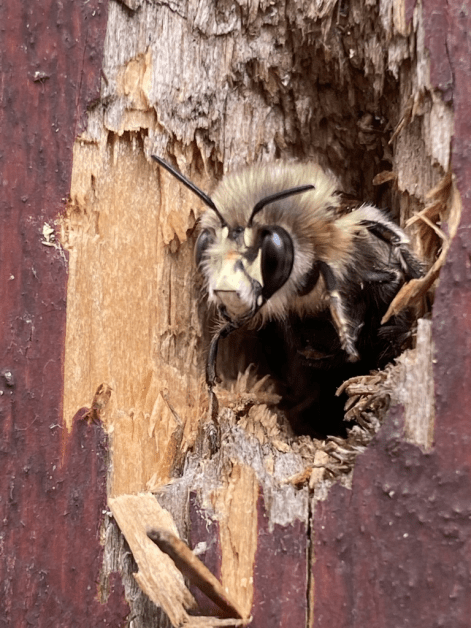
If you’ve visited Meadow Orchard this April you might have noticed a rather distinctive bee visiting our Apple blossom and Broad Beans. One of our lesser-known solitary beed is the hairy-footed flower bee (Anthophora plumipes). Often mistaken for small bumblebees, these bees play an important role in early-season pollination and exhibit several fascinating biological adaptations.
Identification and Characteristics
Anthophora plumipes is a fast-flying, robust bee, typically active from March to May — earlier than many other bee species. Males and females exhibit marked differences:
- Males are covered in tawny-orange hairs, and are easily distinguished by the pale “moustache” of hair on their face and the dense brushes of hair on their middle legs — the feature that gives the species its common name, “hairy-footed.”
- Females are darker (usually black or dark brown) and possess strong hind legs suited for excavating nests.
Despite their superficial resemblance to bumblebees, hairy-footed flower bees can be distinguished by their rapid, darting flight patterns, smaller size, and distinctive loud buzz.
Life Cycle and Behavior
The hairy-footed flower bee is a solitary species, meaning each female independently constructs and provisions her own nest without a social colony structure. Nests are typically excavated into soft mortar, sandy banks, or loose soil, often in walls or cliffs.
The life cycle is strongly synchronized with early spring. Males emerge first — a phenomenon called protandry — and patrol areas rich in early-blooming flowers, seeking out females to mate with.
Once mated, females spend their time digging nesting burrows and gathering pollen and nectar to stock individual brood cells for their larvae.
Mating Behaviour
The male hairy-footed flower bees use their specially adapted, long-haired middle legs during courtship. When a male finds a receptive female, he hovers close and covers her eyes with his hairy front or middle legs!
This behaviour is thought to serve a few possible purposes:
- Calming the female during mating (since bees are often highly visual creatures, reducing visual stimuli might help keep her still).
- Transferring pheromones from the hairs on his legs onto her, possibly increasing the chances of successful mating.
- Physical positioning to help secure a stable mating grip.
The hairs on the male’s legs aren’t just decorative — they’re chemically active structures designed for this very intimate form of interaction!
Ecological Importance
Because of their early emergence, hairy-footed flower bees are critical pollinators for early-flowering plants such as:
- Lungwort (Pulmonaria spp.)
- Comfrey (Symphytum spp.)
- Dead-nettles (Lamium spp.)
- Primroses (Primula spp.)
They are particularly important in cooler, early spring conditions when few other pollinators are active. Their wide foraging range also promotes cross-pollination among multiple plant species, helping maintain healthy plant populations at the very start of the growing season.
Their ability to forage at lower temperatures gives them a unique ecological niche compared to more temperature-sensitive pollinators like honeybees.
Conservation and Habitat Support
Although Anthophora plumipes remains relatively widespread in the UK, its populations depend heavily on the availability of early-season forage and suitable nesting substrates. Urban development, loss of old walls, and heavily managed landscapes can threaten local populations.
Gardeners and land managers can take several steps to support hairy-footed flower bees:
- Plant a range of early-blooming flowers.
- Leave patches of bare, sandy soil or maintain old walls and banks where possible.
By providing nesting sites and floral resources, we can help sustain populations of this essential and fascinating early pollinator.
Join us on iNaturalist
The hairy-footed flower bee, Anthophora plumipes, though often overlooked, plays a vital role in the early spring ecosystem. Supporting solitary species like this one is critical for maintaining resilient and functional pollinator communities, particularly as pressures from habitat loss and climate change intensify.
You can help us build up a comprehensive site survey of our biodiversity by uploading any photos of the wildlife such as these fascinating bees to our iNaturalist project!
 Meadow Orchard Project
You must be logged in to post a comment.